
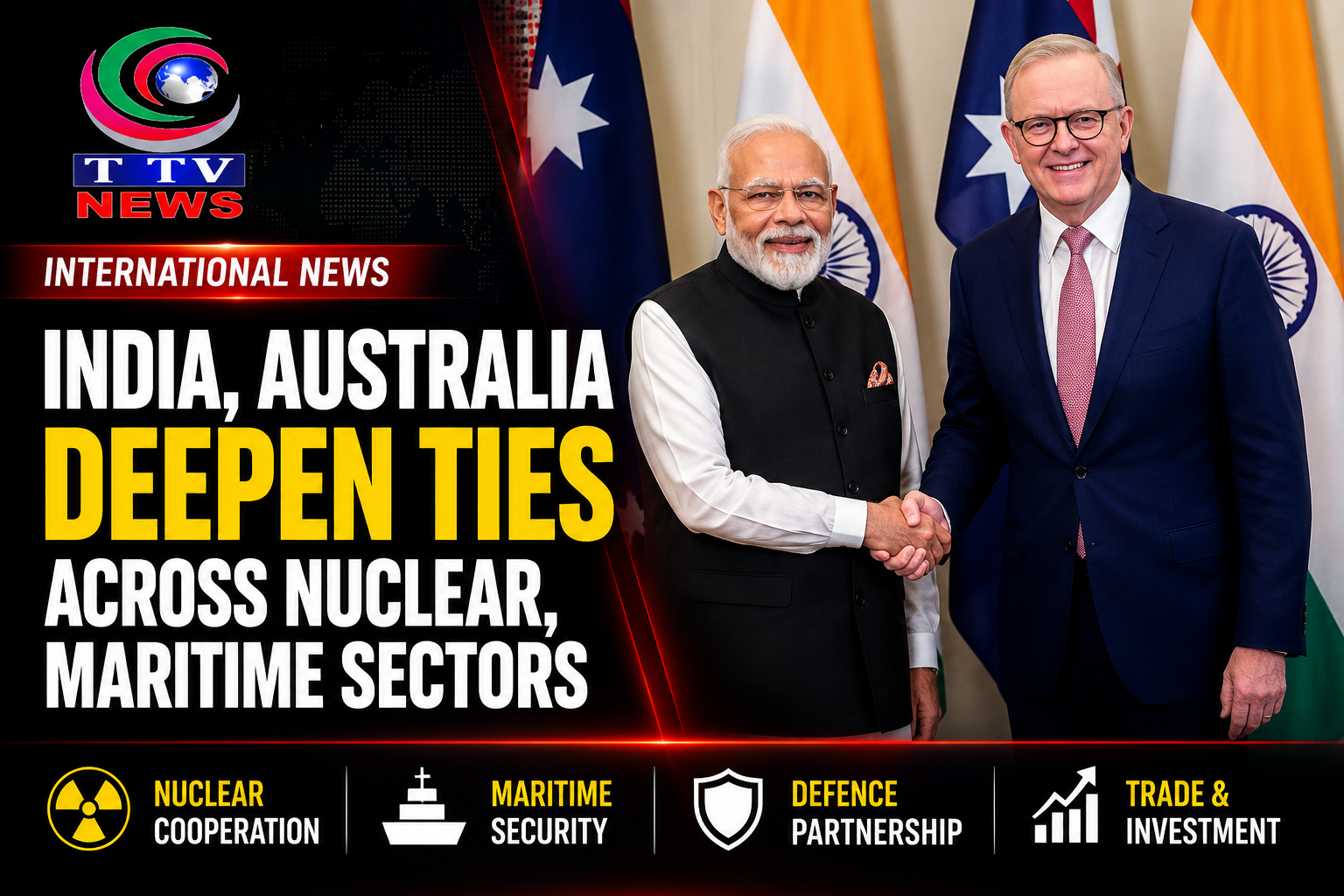
India and Australia have announced a major expansion of their bilateral partnership, with both countries moving closer on civil nuclear cooperation, maritime security, defence collaboration, trade and clean energy.
The fresh push came during high-level talks between Prime Minister Narendra Modi and Australian Prime Minister Anthony Albanese. Both leaders reviewed the growing India-Australia Comprehensive Strategic Partnership and agreed to strengthen cooperation across key strategic and economic sectors.
A major highlight of the talks was progress on uranium exports from Australia to India for peaceful civilian nuclear use. The arrangement is expected to support India’s long-term nuclear energy goals, including its plan to expand clean energy capacity in the coming decades. Australia holds some of the world’s largest uranium reserves, while India is looking to increase nuclear power generation as part of its energy security and climate strategy.
The two sides also agreed to deepen maritime security cooperation in the Indo-Pacific region. This includes stronger defence coordination, better information-sharing, wider naval engagement and closer cooperation on regional security challenges. The move comes as both nations continue to focus on maintaining a free, open and rules-based Indo-Pacific.
India and Australia also discussed defence industry cooperation, military interoperability and joint exercises. Officials said the partnership is increasingly moving beyond traditional diplomacy and is now focused on practical cooperation in security, technology, supply chains and strategic infrastructure.
Clean energy and critical minerals were also key areas of discussion. Australia is an important supplier of minerals needed for renewable energy, electric vehicles and advanced manufacturing. India, meanwhile, is seeking reliable supply chains to support its industrial growth and energy transition.
The leaders also reviewed economic cooperation between the two countries. Bilateral trade has grown in recent years, and both governments are working to expand investment opportunities, improve market access and build stronger business links.
Education, skills, science, technology and people-to-people ties were also part of the wider partnership agenda. The large Indian community in Australia continues to play an important role in strengthening relations between the two countries.
The latest announcements reflect a broader shift in India-Australia relations. Once largely focused on trade and education, the partnership now covers defence, energy, maritime cooperation, critical technologies and regional security.
Both New Delhi and Canberra view each other as important partners in the Indo-Pacific. With shared concerns over supply chain resilience, energy security and maritime stability, the two countries are expected to continue expanding cooperation in the coming years.