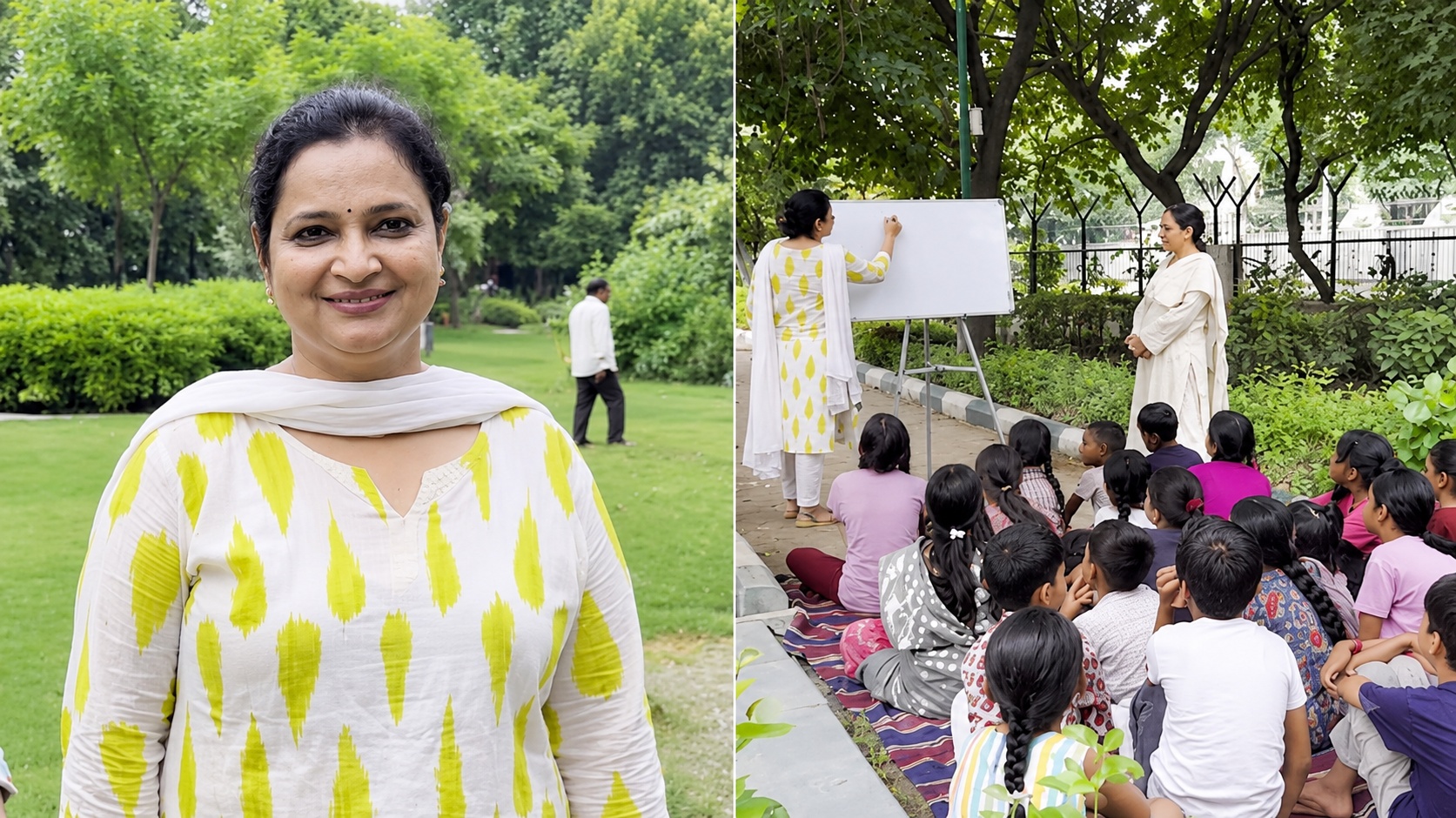
At Balaji Park in Dwarka, Delhi, there are no classrooms, no whiteboards, no desks. For 13 years, there has been something else: Namita Chaudhary, a handful of teaching materials, and children who would otherwise have had nowhere to go.
Chaudhary began in this park with just five children, the sons and daughters of labourers, rickshaw pullers and daily wage workers living near construction sites in the area. Today, more than 200 children are part of the initiative. Over 100 women have also been reached through adult literacy and empowerment programmes running alongside the children's classes.
The sessions cover lessons, drawing, English speaking and activities designed to help children find abilities that textbooks rarely reveal. The park has produced dancers who taught themselves once they were simply told to practise, and students who once hesitated to speak a word of English in public and now teach younger children themselves.
"We have dancers here whom we never formally taught dance. We simply told them to practise properly, and they came back showing us what they could do," Chaudhary says.
The idea, she recalls, grew from a straightforward question she asked herself after moving to Delhi: what could she do with her time that would genuinely improve someone else's life? A visit to an orphanage earlier in her life had already planted the seed. The park became the answer.
"When I leave this place, I want to have the satisfaction of knowing that I made at least one person smile and gave at least one child an education," she says.
As the programme grew, the team recognised that learning difficulties were often rooted in the absence of a supportive environment, not a lack of ability. English speaking became a particular focus for children from Hindi-medium schools who rarely had the chance or the confidence to speak up in public.
Komal, one such student, describes the shift in her own words. “I used to shy away from speaking to anybody, but right now I have learnt to speak and teach students.”
That arc, from hesitant student to returning volunteer teacher, is what Chaudhary considers the programme's real measure of success. Several former students have graduated, found employment and come back to teach the next wave of children at the same park.
"This chain must not stop," she says. “People may change, but the effort to take education into these communities must continue.”
In a city full of schools and colleges, Balaji Park is quietly offering something that many of its children could not access anywhere else: a place to learn, to speak, to create, to grow, and eventually to return and hold the door open for someone new.