
Business: For borrowers considering a gold loan, the amount offered against jewellery is only one part of the calculation. The gold valuation determines how much a lender can potentially advance, while the interest rate, charges and tenure determine how much the borrowing will eventually cost.
When gold prices rise, the value assigned to eligible jewellery can also increase, potentially allowing borrowers to obtain a larger loan against the same quantity of gold. However, lenders apply regulatory limits and their own valuation procedures before determining the final loan amount.
The Reserve Bank of India’s gold and silver collateral framework, which lenders were required to comply with from April 1, 2026, introduced tiered loan-to-value limits for consumption loans. Loans up to Rs 2.5 lakh can have an LTV of up to 85%, loans above Rs 2.5 lakh and up to Rs 5 lakh up to 80%, and loans above Rs 5 lakh up to 75%.
Loan Amount and Interest Rate Are Different
The per-gram advance and the interest rate perform two different functions.
The valuation and applicable LTV determine how much money a borrower can receive against the pledged gold. The interest rate determines the cost of keeping that money outstanding.
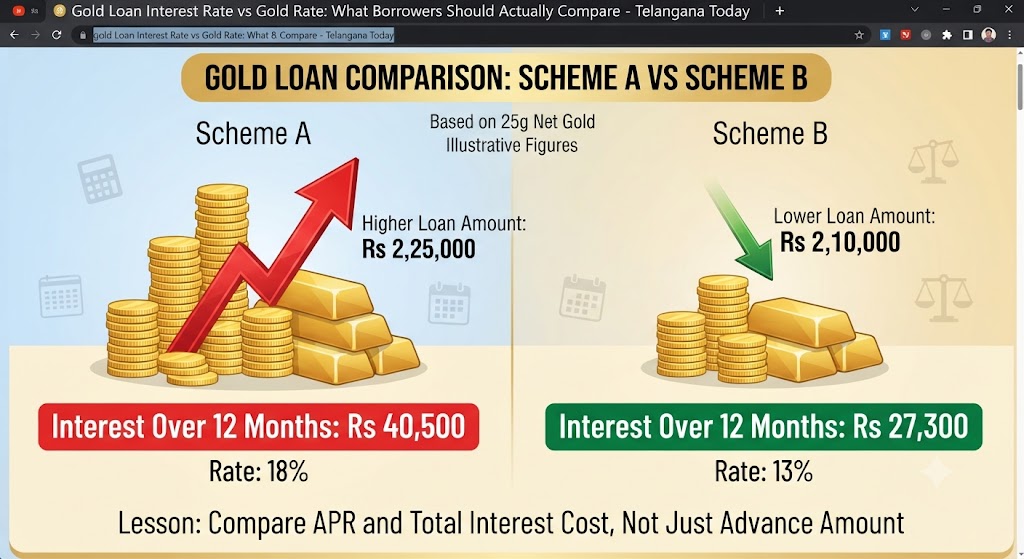
For example, consider two hypothetical schemes for 25 grams of net gold:
| What to compare | Scheme A | Scheme B |
|---|---|---|
| Advance per gram | Rs 9,000 | Rs 8,400 |
| Loan amount against 25 g | Rs 2,25,000 | Rs 2,10,000 |
| Annual interest rate | 18% | 13% |
| Interest over 12 months | Rs 40,500 | Rs 27,300 |
Illustrative figures only.
Scheme A provides Rs 15,000 more upfront, but the assumed annual interest cost is Rs 13,200 higher. If the additional borrowing is not required, taking the larger loan may increase the overall cost without providing a corresponding benefit.
How Gold Loan Amount Is Calculated
The first step is determining the net eligible gold weight. Under the RBI framework, lenders must follow a standardised process for assaying and valuation, including determining the gross and net weight and the purity of the gold. The intrinsic value of the gold is considered, rather than the value of stones or other non-gold components.
For valuation, the RBI framework specifies that lenders should use the lower of the average closing price for the relevant purity over the preceding 30 days or the previous day's closing price, based on prices published by the India Bullion and Jewellers Association or a SEBI-regulated commodity exchange.
The applicable LTV limit is then used to determine the maximum permissible loan amount.
For instance, if a borrower requires Rs 2 lakh and the applicable LTV is 85%, the collateral value would need to be approximately Rs 2.35 lakh. The actual quantity of gold required would depend on its purity, the lender's applicable valuation and the final appraisal.
The RBI framework also requires detailed credit assessment and assessment of repayment capacity for loans exceeding Rs 2.5 lakh.
What Borrowers Should Check
Read the Key Fact Statement: Borrowers should review the Key Fact Statement and understand the Annual Percentage Rate (APR), applicable charges, repayment structure and other costs before signing the agreement.
Check the appraisal: The net weight and purity assessment should be clearly recorded. Borrowers should verify the details on the relevant documents before handing over the jewellery.
Consider the repayment structure: RBI's framework caps bullet-repayment consumption loans at a maximum tenor of 12 months, subject to applicable conditions and renewal rules.
Borrow only what is required: A higher eligible loan amount does not automatically make a loan cheaper. Borrowers should compare the amount actually required with the total cost of borrowing.
What to Check When Choosing a Lender
Borrowers should compare regulated lenders based on the interest rate, APR, processing and other applicable charges, repayment options, tenure and collateral-handling procedures.
Muthoot Finance, for example, states that it offers gold loans with digital repayment options through iMuthoot and Web Pay. Its current loan policy also says pledged gold is protected through measures including strong rooms or safes, CCTV surveillance, security arrangements and insurance coverage. The company states that collateral is ordinarily released on the same day after full repayment and, in any event, within seven working days; where a delay is attributable to the company, it provides for compensation of Rs 5,000 per day beyond seven working days.
Muthoot Finance's current website lists interest rates and scheme-specific terms that vary by product, tenure and repayment structure. Borrowers should check the applicable terms for the specific scheme before proceeding.
Before Taking a Gold Loan
The amount offered against jewellery is important, but it should not be the only consideration.
Borrowers can first determine how much money they actually need, then compare the eligible loan amount, interest rate, APR, fees and total repayment obligation. Checking the appraisal documents and understanding the lender's terms before pledging the jewellery can help borrowers make a more informed borrowing decision.