
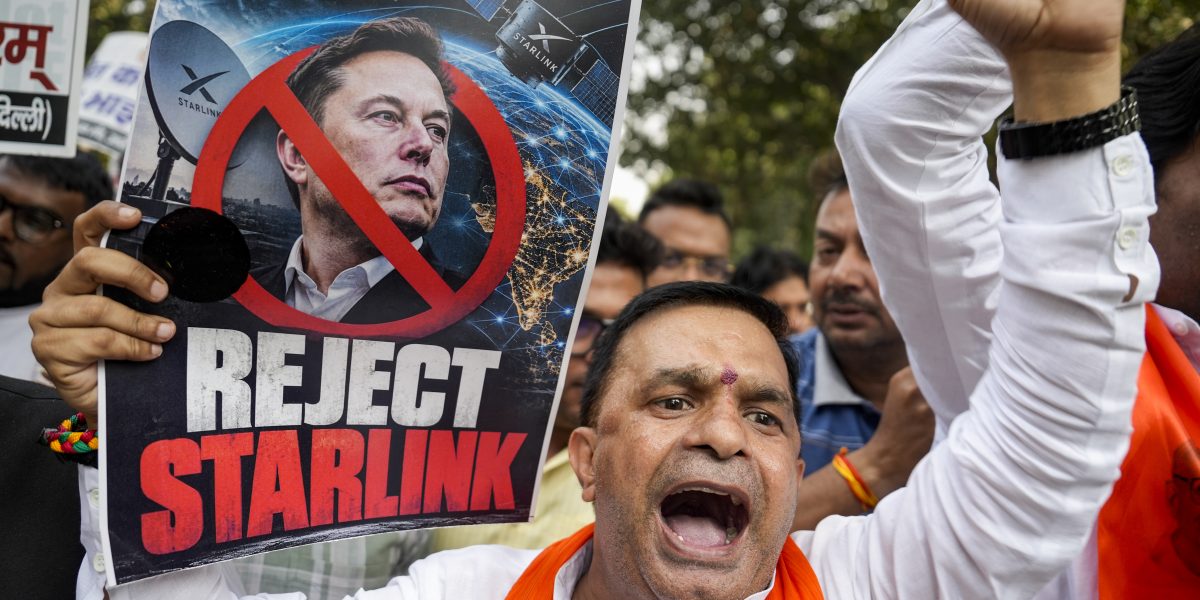
New Delhi: Swadeshi Jagran Manch (SJM), an organisation affiliated with the Rashtriya Swayamsevak Sangh (RSS), has opposed Starlink’s proposed entry into India’s satellite broadband market, arguing that the country should prioritise domestic companies and address potential national security risks.
Ashwini Mahajan, a long-time leader of SJM, made the remarks during a protest against the satellite internet company promoted by Elon Musk. Following the demonstration, the organisation reportedly submitted a memorandum to Prime Minister Narendra Modi, urging the government to reject Starlink’s application.
SJM Raises National Security Concerns
Mahajan claimed that Starlink had not provided satisfactory answers to questions about whether it would comply with Indian government directions to suspend internet services when required.
He also raised concerns about the use of laser-based satellite technology to transmit data, alleging that it could allow information to bypass domestic internet gateways and potentially create security risks.
Mahajan further questioned how Indian consumer data would be protected. However, the available remarks do not clearly establish whether these questions were formally submitted to Starlink, Elon Musk or the Indian government, and the allegations have not been independently verified.
SJM Calls for Domestic Satellite Internet Capabilities
Arguing that India should rely on its own technological capabilities, Mahajan said the country could develop the infrastructure needed to provide satellite-based internet services nationwide.
He expressed confidence that domestic capabilities could be developed within one or two years and called on the government to reject Starlink’s application rather than depend on a foreign provider.
The organisation’s position reflects its broader emphasis on promoting Indian-owned businesses and reducing dependence on foreign companies in strategically important sectors.
Jio, Airtel and Global Satellite Operators in the Race
Starlink is seeking to enter a market that includes Reliance Jio and Bharti Airtel, both of which have established partnerships with international satellite operators.
Jio has partnered with Luxembourg-based SES, while Airtel has tied up with Eutelsat OneWeb, a satellite communications company formed through the combination of Eutelsat and OneWeb.
Both telecom operators have also entered into distribution agreements with SpaceX, Starlink’s parent company. These arrangements highlight the potential for cooperation between established Indian telecom providers and satellite internet operators.
Satellite broadband is expected to help connect remote and underserved areas where conventional fibre-based infrastructure can be difficult or expensive to deploy. Satellite services could complement existing networks by extending connectivity to locations that are challenging to reach through traditional infrastructure.
Starlink Approval Process Faces Delays
Starlink’s proposed Indian launch has faced a lengthy approval process, with discussions reportedly beginning in 2022. Musk has publicly criticised the delays and alleged that powerful business interests were obstructing the company’s entry into the Indian market.
The Union government has rejected allegations that its authorisation framework for telecommunications services is unfair or discriminatory, according to a statement issued by the Ministry of Communications.
Several state governments, including those in Maharashtra, Gujarat, Meghalaya and Goa, have reportedly signed agreements or memorandums of understanding involving Starlink. However, the Union government directed the states to halt related discussions and projects until the company obtains the necessary operating approvals.
Satellite Internet Competition Continues
The debate over Starlink’s entry highlights the competing priorities surrounding India’s satellite broadband sector: expanding connectivity, encouraging domestic industry, attracting investment and protecting national security.
While SJM is calling for a greater focus on Indian capabilities, Starlink’s potential entry could introduce another option for consumers and businesses, particularly in areas with limited broadband access.
The final outcome will depend on regulatory approvals and the government’s assessment of the technical, commercial and security requirements for satellite-based internet services in India.