
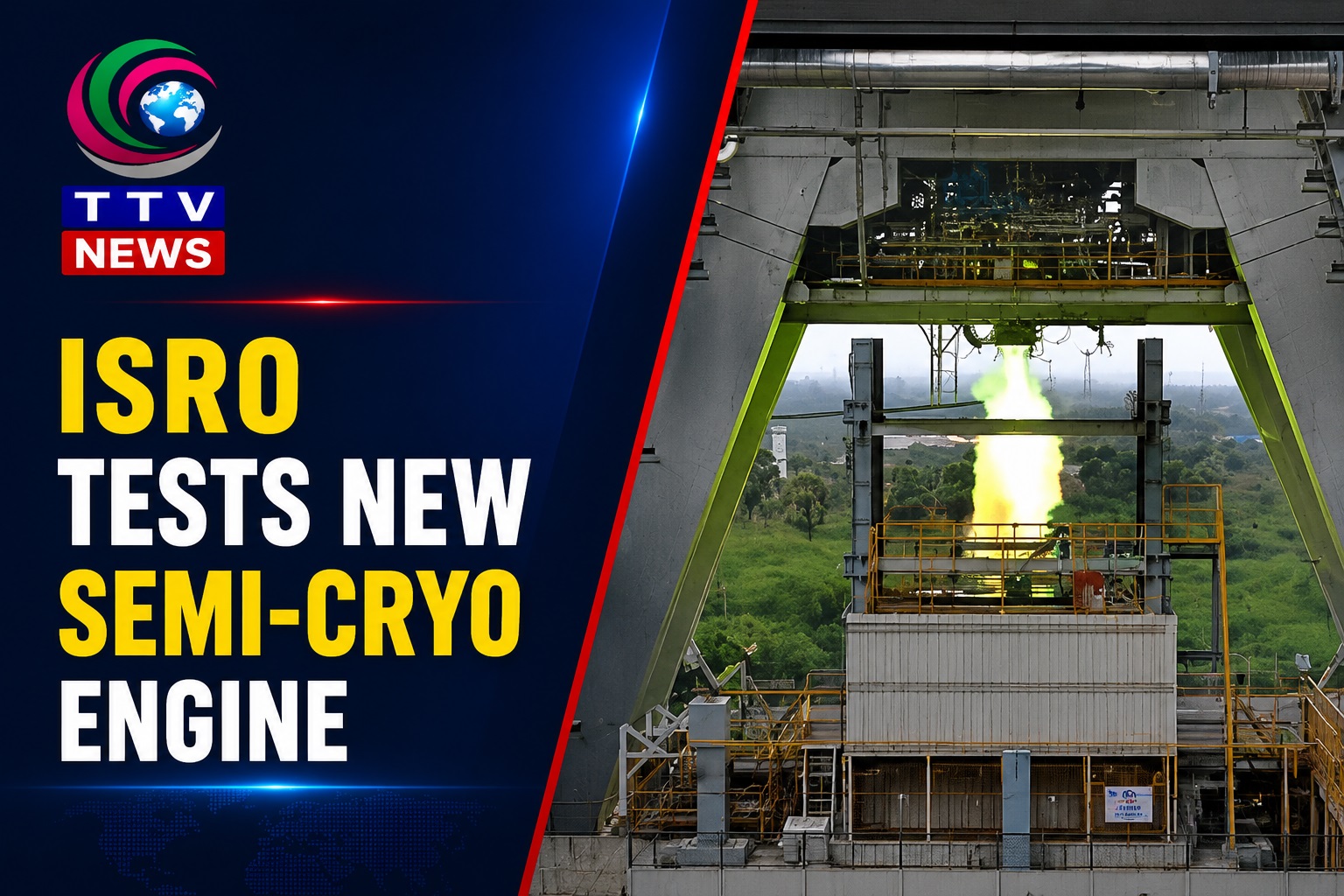
Hyderabad/Chennai: The Indian Space Research Organisation (ISRO) has achieved another significant milestone by successfully conducting a hot test of the Semi-Cryogenic Engine Power Head Test Article (PHTA) at the ISRO Propulsion Complex (IPRC) in Mahendragiri, Tamil Nadu. The test was carried out on June 24 as part of the agency's ongoing efforts to develop advanced propulsion systems for future launch vehicles.
According to ISRO, the latest trial was conducted at a 175-tonne thrust level, representing about 88% of the engine's planned 200-tonne capacity. This is the highest thrust level achieved so far during the ongoing series of PHTA tests.
The Power Head Test Article includes all the critical engine systems except the thrust chamber. During the test, engineers evaluated the engine's performance after pre-burner ignition and confirmed stable operation under higher thrust conditions. The test also verified the successful functioning of the main turbopumps operating at very high outlet pressures.
ISRO stated that all engine parameters performed as expected throughout the trial. The successful demonstration has increased confidence in achieving a full 200-tonne thrust during upcoming tests, bringing the semi-cryogenic engine closer to operational readiness.
The SC120 Semi-Cryogenic Propulsion Stage, powered by the SE2000 engine, is being developed to replace the current L110 core stage of the LVM3 launch vehicle. Once integrated, the upgraded propulsion system is expected to significantly improve the rocket's payload capacity and overall mission efficiency.
Unlike conventional propulsion systems, the new engine uses Liquid Oxygen (LOX) and refined kerosene (Isrosene) as propellants, offering higher performance while using cleaner and more efficient fuels. ISRO believes this technology will play a crucial role in strengthening India's future heavy-lift launch capabilities and upcoming space missions.

.jpg)